Light from the Core: What Neutrino Detectors Are Teaching Us About the Sun's Hidden Engine
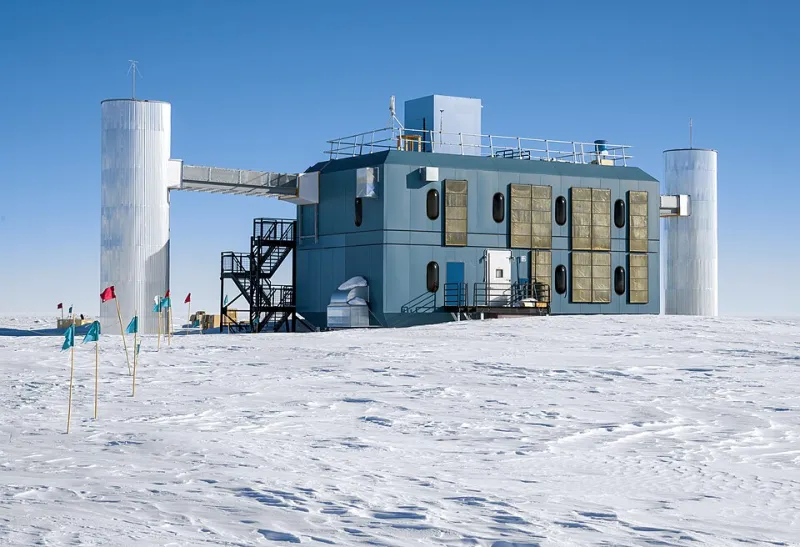
Photo: Christopher Michel, CC BY-SA 4.0, via Wikimedia Commons
For most of human history, the Sun was an object of wonder but not of direct scrutiny. Astronomers could measure its spectrum, map its surface activity, and model its gravitational influence — but the nuclear processes driving it from within remained entirely beyond reach. Light, after all, takes roughly 100,000 years to random-walk its way out from the solar core before it ever reaches your eyes. The Sun's interior, in that sense, is older news than almost anything else in your daily experience.
Neutrinos change that entirely.
Produced in the very instant of nuclear fusion, neutrinos escape the solar core in approximately two seconds and arrive at Earth eight minutes later — carrying information that is, by cosmic standards, essentially live. Two landmark observatories, IceCube Neutrino Observatory in Antarctica and Super-Kamiokande in Japan, have transformed what was once a theoretical promise into an observational discipline. Together, they represent one of the most audacious engineering achievements in the history of experimental physics.
A Particle That Refuses to Cooperate
The neutrino's defining characteristic is its near-total indifference to matter. It carries no electric charge, interacts only through the weak nuclear force and gravity, and passes through the entire Earth as though the planet were not there. Approximately 65 billion solar neutrinos pass through every square centimeter of your skin every second. You will never feel any of them.
This imperviousness made the neutrino extraordinarily difficult to confirm experimentally. Wolfgang Pauli first proposed the particle in 1930 as a theoretical necessity — something had to carry away missing energy in beta decay — but he privately doubted it would ever be detected. It took until 1956 for Clyde Cowan and Frederick Reines to catch neutrinos from a nuclear reactor, an achievement that eventually earned Reines a Nobel Prize in 1995.
Detecting solar neutrinos, however, required an entirely different scale of ambition.
Super-Kamiokande: A Mountain Full of Ultra-Pure Water
Located 3,300 feet beneath Mount Ikeno in the Gifu Prefecture of Japan, Super-Kamiokande is, at its core, a cylindrical tank holding 50,000 metric tons of ultra-pure water. The walls of that tank are lined with roughly 11,000 photomultiplier tubes — sensitive light detectors capable of registering individual photons.
The operating principle exploits a phenomenon called Cherenkov radiation. When a neutrino does, on rare occasion, interact with a water molecule, it can knock loose an electron. If that electron travels faster than the speed of light in water (which is slower than the speed of light in a vacuum), it emits a faint cone of blue light — the optical equivalent of a sonic boom. Super-Kamiokande's photomultiplier array captures that fleeting blue flash and, from the geometry and timing of the signal, reconstructs the energy and direction of the original neutrino.
The data from Super-Kamiokande helped resolve the long-standing "solar neutrino problem" — the troubling discrepancy between the number of neutrinos theorists predicted and the number detectors were actually recording. The answer, confirmed through joint work with the Sudbury Neutrino Observatory in Ontario, Canada, was that neutrinos change flavor as they travel, oscillating between electron, muon, and tau varieties. Detectors sensitive only to electron neutrinos were missing the others. That discovery confirmed neutrinos have mass and earned Takaaki Kajita and Arthur McDonald the 2015 Nobel Prize in Physics.
IceCube: A Cubic Kilometer of Ancient Antarctic Ice
If Super-Kamiokande is a triumph of precision engineering in a confined space, IceCube is a triumph of scale. Operated by a consortium of institutions led by the University of Wisconsin–Madison, IceCube consists of 5,160 digital optical modules suspended on 86 cables drilled more than a mile into the ice sheet at the South Pole.
The ice itself serves as the detection medium. Constructed between 2005 and 2010, the array occupies a full cubic kilometer — making it the largest particle detector ever built. Where Super-Kamiokande excels at detecting lower-energy solar neutrinos, IceCube is optimized for high-energy neutrinos arriving from cosmic sources far beyond our solar system.
In 2017, IceCube recorded a high-energy neutrino event — designated IceCube-170922A — that was traced back to a blazar, a supermassive black hole with a relativistic jet aimed directly at Earth, located approximately 3.7 billion light-years away. It was the first time a neutrino had been linked to a specific astrophysical source beyond our galaxy, marking the opening chapter of what physicists call multi-messenger astronomy.
Supernovae and the 23-Second Warning
Perhaps the most dramatic demonstration of neutrino astronomy occurred not with a sophisticated modern array, but with its predecessors. On February 23, 1987, a supernova erupted in the Large Magellanic Cloud — the closest observed supernova since 1604. Nineteen neutrinos were detected across three separate instruments in a window of approximately 13 seconds, arriving roughly three hours before the first optical light was observed.
Those nineteen particles confirmed decades of theoretical modeling about stellar collapse and provided the first direct evidence that neutrinos carry away the vast majority of energy released in a core-collapse supernova. Modern networks, including the SuperNova Early Warning System (SNEWS), now link neutrino detectors worldwide to provide rapid alerts when a galactic supernova occurs — potentially giving optical astronomers a warning of hours before the explosion becomes visible.
Reading the Sun in Real Time
For solar science specifically, the implications are profound. By measuring the flavor ratios, energy spectra, and arrival rates of solar neutrinos, physicists can probe conditions at the Sun's core with a precision no telescope can match. Recent measurements from the Borexino detector in Italy have even distinguished neutrinos from different branches of the proton-proton fusion chain, confirming that the Sun's energy generation matches theoretical predictions to a remarkable degree of accuracy.
There are still open questions. The precise contribution of the CNO (carbon-nitrogen-oxygen) fusion cycle to the Sun's total energy output remains a subject of active measurement. The absolute abundance of metals in the solar interior — a question with significant implications for stellar modeling — may ultimately be resolved not by spectroscopy, but by neutrino counting.
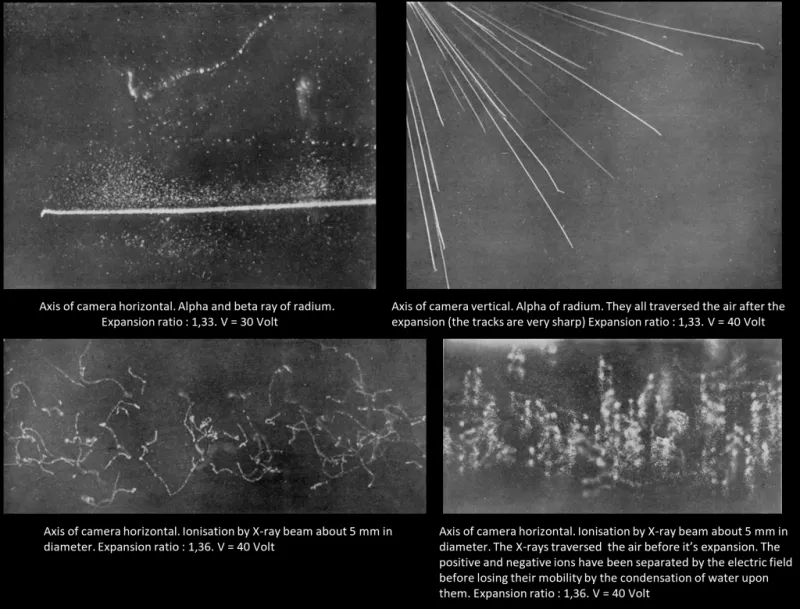
The cloud chamber, that elegant glass box of supersaturated vapor, once made the invisible world of subatomic particles briefly visible as delicate white trails. Today's neutrino observatories operate on an incomparably larger canvas, but the intellectual lineage is direct: find a medium sensitive enough, instrument it carefully enough, and the universe will leave its signature. The Sun has been sending messages for 4.6 billion years. We are only now learning to read them.