A Streak of Light Against the Grain: Carl Anderson and the Discovery That Rewrote the Universe
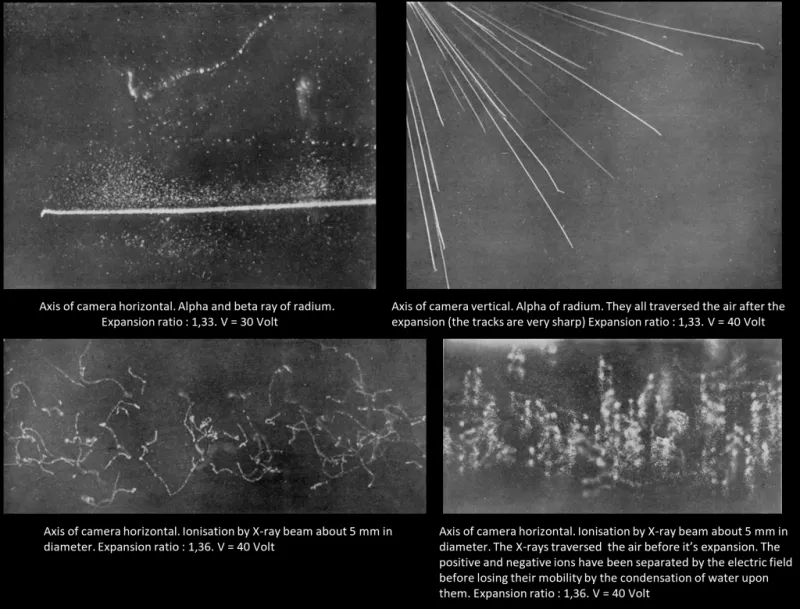
Photo: vintage 1930s physics laboratory cloud chamber particle track photograph black and white, via www.cloudylabs.fr
There is a particular kind of silence that descends in a laboratory when a researcher realizes that what they are looking at cannot be explained by anything currently known to science. Carl David Anderson, a twenty-six-year-old physicist working under Robert Millikan at the California Institute of Technology, likely experienced that silence sometime in August 1932. He was examining a photograph produced by a cloud chamber — a device that renders the paths of subatomic particles visible as delicate white trails in supersaturated vapor — when he noticed a track that curved in precisely the wrong direction.
The particle responsible for that track had the same mass as an electron. But it carried a positive charge. According to everything physics understood at the time, no such particle should exist.
The Stage Is Set: What Cloud Chambers Made Possible
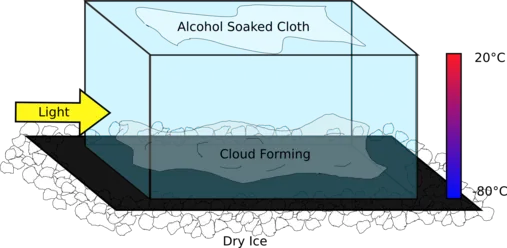
To appreciate why Anderson's discovery was so extraordinary, one must first understand what a cloud chamber actually does. Invented by Scottish physicist Charles Thomson Rees Wilson at the turn of the twentieth century, the device works on a deceptively simple principle. A sealed chamber is filled with air supersaturated with alcohol or water vapor. When a charged particle passes through this environment, it ionizes the gas molecules along its path. Those ionized molecules become nucleation sites — tiny anchors around which vapor condenses into visible droplets. The result is a track: a fine, white thread suspended in space, as legible to a trained physicist as handwriting on a page.
What made the cloud chamber genuinely revolutionary was not merely that it revealed particles, but that it revealed their behavior. Placed within a magnetic field, charged particles curve as they travel — positive charges bending one way, negative charges bending the other. The degree of curvature encodes the particle's momentum. The density and character of the trail encodes its energy and mass. In this way, a single photograph from a cloud chamber could serve as a complete biography of a particle's journey.
By the early 1930s, cloud chambers had already contributed to our understanding of alpha and beta radiation. But no one had yet used one to find something entirely new to physics.
The Photograph That Changed Everything
Anderson had constructed a cloud chamber capable of operating within a powerful magnetic field, with the explicit goal of studying cosmic rays — high-energy particles raining down on Earth from outer space. Cosmic rays were poorly understood at the time, and Millikan's laboratory was among the most active in the country pursuing their characterization.
On August 2, 1932, Anderson captured an image that would later become one of the most reproduced photographs in the history of physics. A lead plate bisected the chamber horizontally. A particle track entered from below, passed through the plate, and continued upward — but with a tighter curve above the plate than below, indicating that the particle had lost energy passing through the lead. This was crucial. By analyzing the curvature on both sides of the plate, Anderson could determine the direction of travel and, therefore, the sign of the charge.
The particle was moving upward. It was curving in the direction associated with a positive charge. And yet its track was far too thin and its curvature far too sharp to belong to a proton. Every measurable property pointed to a particle with the mass of an electron — but with the opposite charge.
Anderson published his findings in the journal Physical Review in September 1932, cautiously introducing what he called a "positive electron." The scientific community was skeptical. The idea of an antiparticle had been proposed theoretically by Paul Dirac in 1928, emerging from his attempt to reconcile quantum mechanics with special relativity. Dirac's equations had stubbornly produced two solutions — one for ordinary electrons, and one for particles with positive charge. Most physicists had dismissed the second solution as a mathematical artifact. Anderson's photograph made dismissal impossible.
Dirac's Prophecy and the Symmetry of Creation
What Anderson had found was the positron — the antimatter counterpart of the electron. Its discovery confirmed that Dirac's equations were not merely producing noise; they were describing a fundamental symmetry of nature. For every particle of ordinary matter, there exists a corresponding antiparticle with identical mass but opposite charge. When a particle and its antiparticle meet, they annihilate each other in a burst of energy.
This symmetry raised an immediate and still-unresolved question: if matter and antimatter are created in equal quantities during energetic events, why does the observable universe appear to consist almost entirely of ordinary matter? The Big Bang, by current theoretical understanding, should have produced equivalent amounts of both. Something caused matter to predominate — a slight asymmetry in the laws of physics that physicists continue to investigate today at facilities like CERN and Fermilab.
Anderson received the Nobel Prize in Physics in 1936 for his discovery. He was thirty-one years old.
The Visual Argument: Why the Track Mattered
It is worth pausing to consider what it meant that antimatter was discovered through a visible trail rather than through a mathematical inference or an indirect measurement. The cloud chamber photograph provided evidence that was, in a very real sense, seeable. Scientists could point to a curve in a photograph and say: here is where the universe revealed something new about itself.
This visual directness carried persuasive weight that equations alone could not. Skeptics could examine the photograph, trace the track with their own eyes, and follow the logical chain from observation to conclusion. The cloud chamber did not merely detect the positron — it made the case for the positron's existence in a form that could be reproduced, shared, and scrutinized across the global scientific community.
In an era before digital imaging and computational analysis, the photograph was the data. And Anderson's photograph was unambiguous.
A Universe More Complicated Than We Imagined
The discovery of antimatter through a cloud chamber trail did not simplify physics — it complicated it in the most productive way possible. It established that the particle zoo was larger than anyone had supposed, that every known particle had a shadow counterpart, and that the vacuum of space was not empty but seething with virtual particle-antiparticle pairs constantly flickering in and out of existence.
Modern positron emission tomography, better known as PET scanning, exploits this same physics to image the human body. Antimatter, first glimpsed as an anomalous curve in a cloud chamber photograph, now assists physicians in diagnosing cancer and neurological disorders in hospitals across the United States.
The trail Anderson photographed in 1932 was approximately ten centimeters long. The implications have proven effectively boundless.