See the Invisible: A Complete Home Guide to Building and Operating Your Own Cloud Chamber
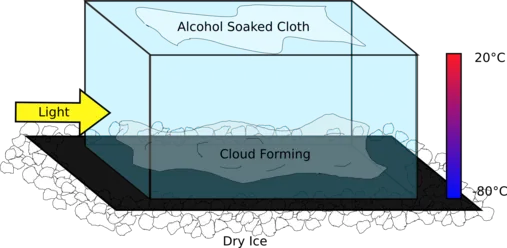
Photo: DIY cloud chamber dry ice isopropyl alcohol particle tracks home experiment science, via www.thenakedscientists.com
You do not need a research institution or a multi-million-dollar budget to observe subatomic particles in motion. With a handful of inexpensive materials available at most hardware and grocery stores, you can construct a functioning cloud chamber at your kitchen table and watch genuine particle tracks form before your eyes—the same fundamental phenomenon that led to the discovery of antimatter in 1932.
This guide walks you through every stage of the process: gathering materials, assembly, operation, troubleshooting, and—most importantly—understanding what you are actually observing when those white wisps materialize in the vapor.
What You Are Building and Why It Works
A cloud chamber functions by maintaining a layer of supersaturated alcohol vapor just above a very cold surface. When a charged particle—an alpha particle from naturally occurring radioactive decay, a cosmic ray muon arriving from the upper atmosphere, or a beta particle from a household radiation source—passes through this vapor, it ionizes the air molecules along its path. Those ionized molecules serve as condensation nuclei, causing tiny alcohol droplets to form in a line that traces the particle's trajectory.
The result is a visible track, typically white or slightly luminous, lasting anywhere from a fraction of a second to several seconds before diffusing. Each track is a direct record of a real subatomic particle in motion.
Materials List
The following items are sufficient to build a functional diffusion-type cloud chamber. Most are available at hardware stores, pharmacies, or online retailers across the United States.
Essential components:
- Clear acrylic or glass tank with a lid (an aquarium, a large clear plastic storage container, or a wide-mouth glass jar all work well; a footprint of at least 6 by 8 inches is recommended)
- Isopropyl alcohol, 99% concentration (do not substitute lower concentrations; 70% rubbing alcohol contains too much water)
- Dry ice (available at many Walmart locations, Kroger stores, and restaurant supply companies; typically sold in pellet or block form)
- Felt or black foam weatherstripping (to line the floor of the chamber)
- Black paint or black construction paper (to create a dark background inside the container)
- A bright flashlight or LED strip light
- A flat metal plate or baking sheet (to sit between the dry ice and the container base)
- Insulating gloves or tongs for handling dry ice
- Duct tape or weatherproof sealant
Optional but helpful:
- A small radioactive source, such as a lantern mantle containing thorium, an old fiestaware dish (uranium glazing), or a Brazil nut (naturally elevated radium content)—these intensify track production
- A rare-earth magnet (to deflect charged particle tracks and demonstrate charge and momentum)
- A camera or smartphone with manual exposure control for photographing tracks
Step-by-Step Assembly
Step 1: Prepare the Interior
Line the interior floor of your container with the black felt or foam weatherstripping. This dark surface is essential—particle tracks appear white and are nearly impossible to see against a light background. If using a clear-bottomed container, paint or tape black paper to the outside of the base to achieve the same effect. Ensure the interior walls are also as dark as possible.
Step 2: Saturate the Felt With Alcohol
Pour approximately one to two tablespoons of 99% isopropyl alcohol directly onto the felt lining. Tilt the container gently to distribute the alcohol evenly. The felt should be thoroughly damp but not pooling with excess liquid. The alcohol will evaporate continuously during operation, maintaining the supersaturated vapor layer.
Step 3: Seal the Container
Place the lid firmly on the container. If your container is not airtight, use duct tape or sealant around the seam. A tight seal prevents air currents from disrupting the delicate vapor layer, which is one of the most common causes of poor track visibility.
Step 4: Set Up the Cooling Stage
Place your flat metal plate on a stable, heat-resistant surface. Arrange the dry ice on the plate—if using a block, break it into pieces that cover the plate surface evenly. Using insulating gloves, set your sealed container directly on top of the dry ice. The metal plate accelerates heat transfer between the dry ice and the container base, cooling the interior floor to approximately -78°C (-109°F).
Step 5: Allow the Chamber to Stabilize
This is the step that requires the most patience. Allow the chamber to cool for a minimum of five minutes, and ideally ten to fifteen. During this period, a temperature gradient establishes itself inside the container: the top is warm (near room temperature) and the bottom is extremely cold. Alcohol vapor evaporating from the felt sinks toward the cold floor, becoming supersaturated as it cools. This supersaturated zone, typically occupying the bottom half-inch to inch of the chamber, is where particle tracks will appear.
Step 6: Illuminate and Observe
Dim the ambient lighting in your room as much as possible. Shine your flashlight or LED strip horizontally through the side of the container, parallel to and just above the cold floor. The light should skim across the supersaturated layer rather than shine directly down into it. Look through the top or side of the container at the illuminated zone.
After a brief additional wait, you should begin seeing tracks—short dashes, long streaks, or branching lines materializing and then dissipating in the vapor.
What the Tracks Are Telling You
Not all tracks look alike, and the differences are meaningful. Understanding track morphology connects your home experiment directly to the same interpretive framework professional physicists use.
Thick, short, straight tracks are characteristic of alpha particles. Alpha particles are relatively massive and doubly charged, so they ionize air molecules intensely over a short distance. Their tracks appear dense and stubby. Thorium-bearing lantern mantles are a convenient household source of alpha emitters.
Thin, long, occasionally curved tracks indicate beta particles (high-speed electrons). Beta particles are much lighter and carry a single charge, so they ionize less intensely and travel farther before stopping. Their tracks are fainter and may show slight bends where the particles have scattered off air nuclei.
Long, straight, minimally ionizing tracks that cross the entire chamber without stopping are almost certainly cosmic ray muons. These particles originate from cosmic ray interactions in the upper atmosphere, roughly ten miles above your head, and they pass through your chamber—and through your body—continuously. Muon tracks are among the most striking to observe because they appear sudden, straight, and decisive, crossing the full width of the chamber as though the walls were not there.
Forked or V-shaped tracks indicate a decay event or a nuclear collision occurring within the chamber volume itself. These are less common but represent exactly the type of signature that led to major discoveries in the mid-twentieth century.
Troubleshooting Common Problems
No tracks visible after fifteen minutes: Verify that your alcohol is 99% isopropyl, not 70%. Check that your container is sealed and that the dry ice is making solid contact with the base. Ensure your observation light is truly horizontal and close to the floor level.
Turbulent or swirling vapor instead of clear tracks: Air currents are disrupting the vapor layer. Check your seal and avoid touching or moving the chamber during observation. Even breath on the container surface can introduce enough thermal variation to destroy the supersaturated layer temporarily.
Tracks appear but disappear almost instantly: This is normal behavior—tracks typically last one to five seconds. If they are disappearing faster than you can register them, try reducing ambient light further and adjusting the flashlight angle.
Dry ice exhausted quickly: Dry ice sublimates rapidly at room temperature. For extended observation sessions, start with at least two to three pounds and keep the surrounding environment as cool as possible.
Safety Considerations
This experiment is genuinely safe when conducted with appropriate care. Dry ice causes cold burns on contact with bare skin; always use insulating gloves or tongs. Isopropyl alcohol is flammable—keep it away from open flames and ensure the area is well ventilated. If you are using a naturally radioactive source such as a lantern mantle, handle it minimally and wash your hands afterward. The radiation levels involved are far below any threshold of health concern, but prudent handling is always advisable.
From Your Kitchen Table to the Cavendish Laboratory
The apparatus you have built is, in its essential operating principle, identical to the instrument with which Carl Anderson photographed the first positron in 1932 and with which Rochester and Butler discovered strange particles in 1947. The physics is unchanged. The particles streaming through your chamber tonight are the same particles that have been crossing Earth's surface since long before any human thought to look for them.
That is the enduring gift of the cloud chamber: it makes the invisible tangible, the abstract concrete, and the distant intimately present. Every track you observe is a genuine event in the subatomic world, recorded in vapor, witnessed by you.