Vapor, Vision, and Discovery: The Cloud Chamber's Unmatched Legacy in Particle Physics
Before billion-dollar colliders and digital detectors, a Scottish physicist filled a glass chamber with supersaturated vapor and watched the invisible world announce itself in delicate white trails. The cloud chamber did not merely detect particles—it made the subatomic universe visible for the first time, and in doing so, rewrote the laws of physics as we understood them.
A Simple Idea With Profound Consequences
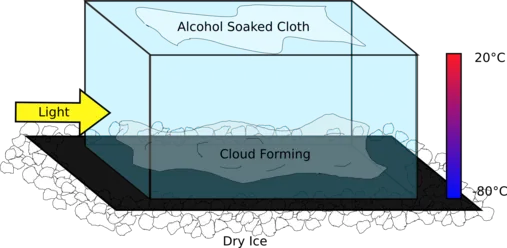
In 1911, Charles Thomson Rees Wilson, working at Cambridge University's Cavendish Laboratory, perfected an instrument he had been refining for nearly two decades. His original motivation was surprisingly poetic: Wilson wanted to reproduce the optical effects he had observed atop Ben Nevis, Scotland's highest mountain, where sunlight scattered through fog created halos and coronas of breathtaking beauty. To study these atmospheric phenomena in a controlled setting, he constructed a chamber that could generate artificial clouds.
What Wilson discovered, almost as a secondary consequence, was that ionizing radiation left unmistakable condensation trails as it passed through supersaturated air. Charged particles displaced electrons from gas molecules along their trajectories, creating microscopic ion clusters that acted as seeds for water droplet formation. The result was a visible track—a ghostly white line hanging in the vapor—that recorded the particle's passage with a fidelity no other instrument of the era could match.
Wilson received the Nobel Prize in Physics in 1927 for this invention, sharing the honor with Arthur Compton. Yet the award understated the instrument's ultimate contribution. The cloud chamber was not simply a tool; it was a window into a previously inaccessible dimension of physical reality.
The Timeline of Transformation
The discoveries that unfolded through cloud chamber observation over the subsequent three decades constitute one of the most concentrated periods of fundamental discovery in the history of science.
1919–1923: Cosmic Ray Confirmation. Robert Millikan, the American physicist best known for his oil-drop experiment measuring the electron's charge, used cloud chamber observations alongside other instruments to characterize cosmic rays—high-energy particles streaming into Earth's atmosphere from outer space. While the debate over their nature persisted into the 1930s, cloud chamber tracks provided direct evidence of their existence as particle radiation rather than electromagnetic waves.
1932: The Positron and the Birth of Antimatter. Perhaps no single cloud chamber photograph altered the course of physics more dramatically than the image captured by Carl David Anderson at Caltech in August 1932. Analyzing tracks produced by cosmic rays in a chamber placed within a strong magnetic field, Anderson observed a particle that curved in the opposite direction from an electron—identical in mass but opposite in charge. He had discovered the positron, the first known antiparticle.
Paul Dirac had theoretically predicted antimatter's existence three years earlier, but Anderson's photograph transformed mathematical abstraction into empirical fact. A single image, produced by an instrument costing a fraction of what modern detectors require, confirmed one of the most consequential predictions in theoretical physics. Anderson received his own Nobel Prize in 1936.
1936: The Muon's Unexpected Arrival. Also working at Caltech, Anderson and his colleague Seth Neddermeyer detected another anomalous track in their cloud chamber—a particle heavier than an electron but lighter than a proton. Initially mistaken for the pion that Hideki Yukawa had predicted as the carrier of the nuclear force, the particle was eventually identified as the muon. Its existence was so unexpected that physicist Isidor Rabi famously asked, "Who ordered that?" The muon remains one of the more enigmatic elementary particles, and its discovery illustrated that the subatomic world was far richer than theorists had anticipated.
1947: Strange Particles and a New Quantum Number. Using cloud chambers placed at high altitudes to capture cosmic ray interactions, physicists George Rochester and Clifford Butler at the University of Manchester observed tracks forming distinctive V-shaped patterns. These signatures indicated particles decaying in mid-flight into lighter products—particles that were produced readily but decayed slowly, a contradiction that eventually led to the concept of "strangeness" as a conserved quantum number. The strange quark would not be named until the 1960s, but Rochester and Butler's cloud chamber photographs planted the seed.
Why the Cloud Chamber Competed With the Colossus
It is worth pausing to consider what made the cloud chamber so extraordinarily productive despite its apparent simplicity. Modern particle detectors—the Large Hadron Collider's ATLAS and CMS experiments, for instance—occupy caverns the size of cathedral naves, employ thousands of scientists, and cost billions of dollars to construct and operate. The cloud chamber, by contrast, could be assembled on a laboratory bench.
The answer lies in the nature of visual evidence. Cloud chamber photographs provided an immediate, intuitive record of particle behavior. Researchers could literally see the curvature of a track in a magnetic field, estimate a particle's momentum from the radius of curvature, infer its charge from the direction of bending, and assess its mass from the density and length of the trail. These were measurements that required no elaborate digital reconstruction. The image itself was the data.
This directness also made cloud chamber results uniquely persuasive to the broader scientific community. When Anderson submitted his positron photograph to the Physical Review, skeptics could examine the image and follow his reasoning without requiring specialized knowledge of electronic detector systems. Visual evidence carries a rhetorical power that numerical outputs from modern detectors cannot fully replicate.
Quantum Reality Made Tangible
Beyond specific discoveries, the cloud chamber accomplished something philosophically significant: it demonstrated that quantum mechanics, for all its mathematical abstraction, described phenomena that were physically real and experimentally accessible.
The tracks left by alpha particles, beta particles, and cosmic ray muons were not theoretical constructs. They were condensation trails photographed on glass plates, archived in journals, and reproduced in textbooks that generations of American physics students would study throughout the twentieth century. The quantum world was strange, certainly—but it was not merely metaphorical. It left marks.
This grounding of quantum reality in visible evidence helped establish the intellectual foundation upon which subsequent particle physics was built. Every accelerator experiment, every bubble chamber photograph, every silicon strip detector readout traces its conceptual lineage back to Wilson's vapor-filled chamber and the white lines that materialized within it.
The Instrument That Launched a Discipline
The cloud chamber was eventually supplanted by more sensitive and more versatile detection technologies. Donald Glaser's bubble chamber, introduced in 1952, offered superior track resolution and the ability to handle the higher-energy particles produced by the new generation of particle accelerators. Electronic detectors followed, ultimately enabling the automated, high-volume data collection that modern collider experiments demand.
Yet the cloud chamber's place in the history of science is secure. In a period spanning roughly thirty-five years, a device built from glass, metal, and water vapor provided the first visual confirmation of antimatter, revealed the existence of muons and strange particles, and helped establish cosmic rays as a genuine astrophysical phenomenon. It transformed particle physics from a theoretical enterprise into an observational science.
For those who study the history of discovery, the cloud chamber represents a reminder that transformative science does not always require the largest instrument or the largest budget. Sometimes it requires only a supersaturated vapor, a source of ionizing radiation, and the patience to watch what appears in the mist.