Droplets to Digital: How Particle Detection Grew from a Glass Box into a Global Science
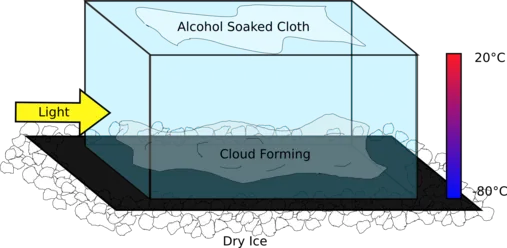
If you have ever built a cloud chamber at home — or watched one operating at a science museum, fog slowly settling while cosmic ray tracks scratch white lines through the air — you have participated in a tradition that stretches directly back to C.T.R. Wilson's Scottish laboratory at the dawn of the twentieth century. The apparatus in your hands or on the table before you operates on the same core principle that guided particle physics for decades: make the invisible visible by giving it something to disturb.
That principle did not become obsolete. It evolved. And tracing that evolution from Wilson's original glass expansion chambers through bubble chambers, wire chambers, and finally to the layered silicon detectors inside the Large Hadron Collider's experiments reveals something important about how science actually progresses — not by discarding old ideas, but by translating them into new physical languages.
The Original Instrument: Elegant and Limited
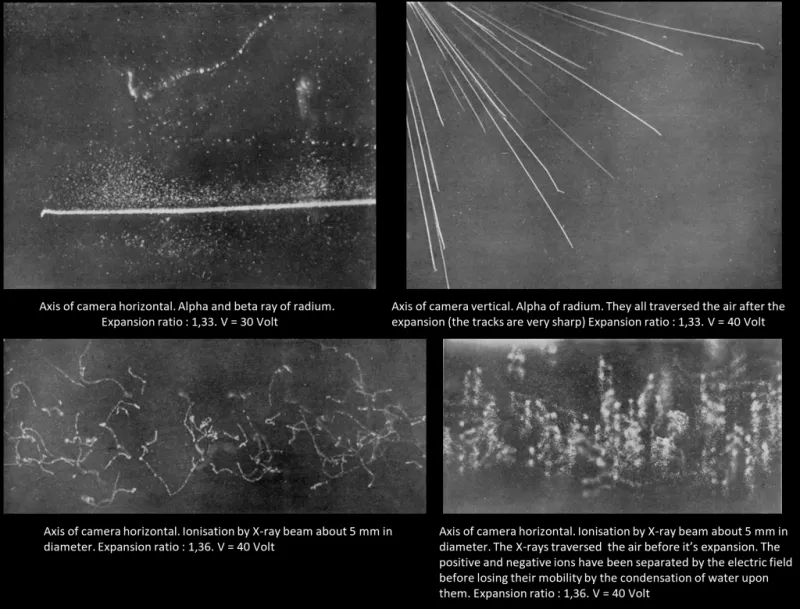
Charles Wilson completed his first working cloud chamber in 1911, though he had been developing the concept since the 1890s. The device was conceptually straightforward: a cylinder of moist air, rapidly expanded to cool and supersaturate the vapor, then illuminated and photographed as charged particles left condensation trails in their wake. Wilson's chambers were hand-operated, required careful timing, and could capture only a limited number of events before the vapor needed to be reset.
For the physics of the 1920s and early 1930s, these limitations were acceptable. Cosmic ray fluxes were low, and experimenters were content to wait patiently for interesting events. The cloud chamber's great virtue was its completeness: every track it recorded was a full three-dimensional trajectory, readable in terms of charge, momentum, and energy with the right magnetic field applied.
But as physicists began asking more demanding questions — about the frequency of rare interactions, about the precise geometry of particle decays, about events that unfolded in fractions of a nanosecond — the cloud chamber's inherent slowness became a genuine obstacle. It could not be triggered fast enough to capture every event of interest, and its sensitive volume was relatively small. Something faster and denser was needed.
The Bubble Chamber: Trading Vapor for Liquid
The next major leap arrived in 1952, when Donald Glaser at the University of Michigan demonstrated that a superheated liquid could serve the same function as supersaturated vapor. In a bubble chamber, liquid hydrogen (or another suitable fluid) is held just above its boiling point under elevated pressure. When a charged particle passes through, it deposits enough energy to initiate local boiling along its path, leaving a trail of tiny bubbles rather than condensation droplets.
The advantages were immediate and significant. Liquid hydrogen is far denser than vapor, which means particles interact with it far more frequently. A bubble chamber could serve simultaneously as both the target material and the detector — a particle beam could be directed straight into the liquid, and the resulting collision products would leave their trails in the same medium. Luis Alvarez at Lawrence Berkeley National Laboratory in California pushed bubble chamber technology to its practical limits during the 1950s and 1960s, developing enormous hydrogen chambers and the scanning techniques necessary to analyze the millions of photographs they produced.
Glaser received the Nobel Prize in Physics in 1960. Alvarez followed in 1968.
Bubble chambers were visually spectacular. Their photographs — large-format images showing spiraling tracks, forking decay products, and the clean geometry of particle collisions — became iconic representations of experimental physics. Many are still reproduced in introductory physics textbooks used in American high schools and universities.
But bubble chambers shared one critical limitation with their cloud chamber predecessors: they were fundamentally photographic instruments. Human beings, or later computers, had to scan the images and identify events of interest after the fact. They could not make real-time decisions about which events to record and which to discard — a capability that would become essential as beam intensities increased.
Wire Chambers and the Electronic Revolution
The transition from visual to electronic detection began in earnest with the development of the multiwire proportional chamber by Georges Charpak at CERN in 1968. Charpak's insight was to replace the photographic medium with a grid of fine wires held at high voltage within a gas-filled enclosure. A passing charged particle ionizes the gas; the freed electrons drift toward the nearest wire and produce an electrical pulse. By reading out thousands of wires simultaneously, physicists could reconstruct particle trajectories in real time, without any photographic film or human scanning.
This was transformative. Electronic readout meant that detectors could be connected to trigger systems — logic circuits that recognized potentially interesting events and instructed the detector to record them while discarding the overwhelming majority of mundane interactions. At high-energy accelerators, where beams collide millions of times per second, this selectivity is not a convenience but a necessity.
Charpak received the Nobel Prize in Physics in 1992. His wire chamber technology, refined and elaborated in countless subsequent designs, became the backbone of particle physics experiments for the following three decades.
Modern Megadetectors: The LHC Era
The detectors operating today at CERN's Large Hadron Collider — ATLAS and CMS being the most prominent — represent the culmination of this century-long development. Each is essentially a city-block-sized onion of specialized detection layers, each designed to measure a different property of the particles produced when proton beams collide at energies approaching fourteen trillion electron volts.
The innermost layers consist of silicon pixel detectors, capable of recording particle positions to within a few micrometers. Surrounding these are tracking chambers filled with gas, operating on principles directly descended from Charpak's wire chambers. Calorimeters — dense blocks of material that stop particles and measure their total energy — form the next layers. Outermost lie muon detectors, because muons are the only common particles that penetrate all the inner material and survive to reach the exterior.
When the Higgs boson was announced in July 2012, the evidence came from these layered digital systems, which had collectively analyzed hundreds of trillions of collisions and identified a statistically significant excess of events matching the predicted signature. No human eye examined individual tracks. Algorithms processed the data, physicists interpreted the statistical patterns, and a particle first theorized in 1964 was confirmed.
Why the Cloud Chamber Still Belongs in the Conversation
Given this progression toward ever-greater complexity and abstraction, one might reasonably ask why cloud chambers retain any relevance beyond historical curiosity. The answer is partly pedagogical and partly philosophical.
Pedagogically, no other instrument makes particle physics as immediately intuitive. When a student in a classroom or a hobbyist in a basement watches a cosmic ray muon draw a straight line through a homemade cloud chamber, the physics is not mediated by software or statistical inference. The track is there. The particle was there. The connection between cause and visible effect is direct in a way that a histogram of collision data simply cannot replicate.
Philosophically, the cloud chamber embodies the core logic of all particle detection: perturb a sensitive medium, observe the disturbance, infer the cause. Every detector from Wilson's original apparatus to the silicon trackers inside ATLAS operates on this same logic. Teaching that logic through a device that makes it visible is not a step backward — it is the most honest possible introduction to what experimental particle physics actually does.
Many professional physicists report that their intuition about particle behavior was first formed watching cloud chamber tracks. That intuition — the sense of what a high-momentum particle looks like versus a low-momentum one, what a decay vertex looks like, what the difference between an electron and a muon means in terms of track character — persists through careers spent working with data that is purely digital.
The glass box and the billion-dollar detector are, at their cores, the same instrument. One makes the invisible visible with droplets of alcohol. The other does it with silicon and statistics. But both are asking the same question that C.T.R. Wilson first posed in a Scottish laboratory more than a century ago: what left that mark, and what does it tell us about the world we cannot otherwise see?