Algorithms in the Fog: Artificial Intelligence Learns to Read Particle Trails
In the early decades of experimental particle physics, reading a cloud chamber photograph was a skill acquired slowly and maintained through constant practice. Physicists and their graduate students would spend hours bent over light tables, tracing the curved arcs and branching forks of particle tracks with magnifying loupes and grease pencils, cataloging events by hand into ledgers that would eventually be compiled into datasets. It was painstaking, methodical work — and it was the foundation upon which the Standard Model of particle physics was built.
That era of human visual interpretation is not over, but it is being profoundly transformed. Across research institutions in the United States and abroad, teams of physicists and computer scientists are deploying machine learning systems capable of analyzing particle track images at scales and speeds that no human analyst could approach. The implications extend backward through history as well as forward into the future of experimental science.
A Language Developed Over Decades
To appreciate what artificial intelligence is being asked to learn, it helps to understand what particle tracks actually communicate. When a charged particle travels through a medium — whether the supersaturated vapor of a cloud chamber, the liquid hydrogen of a bubble chamber, or the silicon strips of a modern solid-state detector — it leaves behind a record of its passage. The geometry of that record encodes the particle's identity, its energy, its charge, and its interactions with other particles.
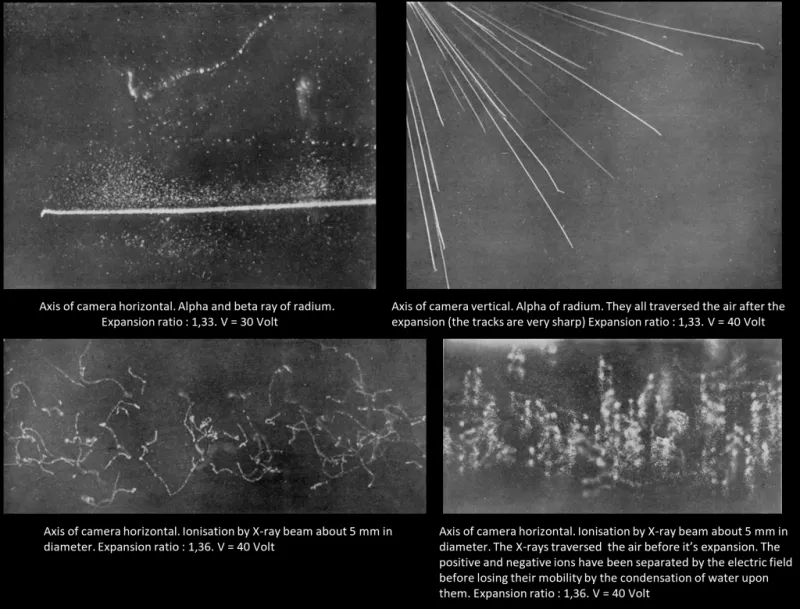
An alpha particle, heavy and doubly charged, produces a thick, straight track that terminates abruptly. An electron, far lighter, curves dramatically in a magnetic field and leaves a thin, often spiraling trail. A neutral particle leaves no track at all but announces its existence through the V-shaped signature of its decay products. Physicists developed the interpretive grammar for these visual signatures over many decades, beginning with C.T.R. Wilson's original cloud chamber experiments in the early twentieth century and continuing through the bubble chamber era of the 1950s and 1960s.
The challenge now confronting AI researchers is to encode that grammar into a computational system — to teach an algorithm what took human physicists generations to learn.
Training on History
One of the more unexpected applications of modern machine learning in physics involves the reanalysis of historical data. Institutions including the American Institute of Physics, CERN, and several university archives hold extensive collections of cloud chamber and bubble chamber photographs taken during the mid-twentieth century. Many of these images were analyzed at the time they were produced, but the analytical tools available to researchers of that era were limited by both technology and theoretical frameworks that have since been substantially revised.
Researchers at several institutions have begun digitizing these archives at high resolution and feeding the resulting image libraries into convolutional neural networks — a class of AI architecture particularly well suited to visual pattern recognition. The networks are trained on images whose events have already been identified and cataloged, allowing them to develop internal representations of what different particle interactions look like.
Once trained, these systems can then be applied to images that were never fully analyzed, or to reexamine previously studied photographs with fresh algorithmic eyes. The possibility that rare or anomalous events documented in mid-century photographs might have been overlooked — and might now be recoverable — has generated considerable excitement in certain corners of the physics community.
Speed, Scale, and Sensitivity
In contemporary experimental settings, the motivation for AI-assisted track analysis is somewhat different. Modern particle detectors at facilities such as Fermilab in Illinois and the SLAC National Accelerator Laboratory in California generate data at rates that make comprehensive human review impossible. The Large Hadron Collider at CERN produces roughly fifteen petabytes of data annually — a volume that would require an implausible number of human analysts working continuously to examine in full.
Machine learning systems can process this data orders of magnitude faster than human reviewers, flagging candidate events for closer examination and discarding the vast majority of routine interactions that hold little scientific interest. This filtering function is not merely a matter of efficiency; it is, at this point, a practical necessity for the operation of high-luminosity collider experiments.
Beyond raw speed, AI systems offer a form of sensitivity that complements rather than duplicates human perception. Human analysts are highly effective at recognizing patterns they have been trained to expect, but this same expertise can create blind spots — a tendency to overlook events that do not conform to established categories. Neural networks, which develop their own internal classification criteria during training, may identify statistically unusual events that a human reviewer might unconsciously normalize or dismiss.
This property has led some researchers to use AI systems specifically as anomaly detectors, tasking them not with identifying known particle types but with flagging interactions that deviate from expected patterns. In a field where the discovery of genuinely new phenomena depends on identifying precisely such deviations, this application carries significant scientific weight.
The Question of Interpretability
The integration of machine learning into particle physics is not without its complications. A persistent concern among physicists involves what researchers call the interpretability problem: the difficulty of understanding why a neural network reaches a particular conclusion. When a trained human analyst identifies a particle track, they can articulate their reasoning in terms of physical principles. When a neural network classifies the same image, its decision emerges from millions of weighted numerical parameters that resist straightforward explanation.
This opacity creates a verification challenge. If an AI system flags an anomalous event as potentially significant, physicists must determine whether the anomaly reflects genuine new physics, an artifact of the detector, or an idiosyncrasy of the training data. Resolving that question requires methods for probing the network's internal representations — an active area of research sometimes described as explainable AI — as well as independent confirmation through alternative analytical approaches.
The physics community has approached this challenge with characteristic rigor, insisting that AI-assisted discoveries meet the same statistical and methodological standards as those reached through traditional analysis. The tools are new; the standards of evidence are not.
Continuity Across a Century
There is something philosophically fitting about the application of twenty-first-century artificial intelligence to the visual records of twentieth-century experimental physics. The cloud chamber was itself a technology for making the invisible visible — for rendering the abstract reality of subatomic particles into a form that human senses could directly apprehend. The images it produced were not merely data; they were a kind of testimony, evidence offered to the eye.
AI systems trained on those images are, in a sense, learning to read that testimony — to extract meaning from visual records that were created long before the tools to fully interpret them existed. The particle trails documented in archived photographs from the 1940s and 1950s have not changed. What has changed is our capacity to ask questions of them.
In this light, the application of machine learning to particle track analysis is less a rupture with the past than a continuation of it — another chapter in the long effort to hear what the subatomic world has been trying to tell us all along.