Basement Physicists: How Ordinary Americans Are Detecting Cosmic Particles at Home
Every second of every day, streams of subatomic particles called muons rain down through the atmosphere and pass silently through your body, your walls, and the floor beneath your feet. Most people will never know this is happening. But in basements from Boise to Baltimore, a dedicated community of amateur scientists has decided that invisibility is no longer acceptable — and they are building the instruments to prove it.
The DIY particle detection movement has grown considerably over the past decade, fueled by the convergence of affordable microelectronics, open-source hardware platforms, and an online culture that prizes the sharing of technical knowledge. What was once the exclusive domain of university physics departments and national laboratories is increasingly accessible to anyone with patience, a soldering iron, and a few hundred dollars to spend.
From Curiosity to Construction
The entry point for most hobbyists is simpler than one might expect. Scintillator-based muon detectors — devices that use plastic or crystal materials to produce tiny flashes of light when a charged particle passes through — can be assembled using components sourced from electronics suppliers and surplus scientific equipment markets. A basic two-panel coincidence detector, which registers a muon only when it triggers both panels in rapid succession, can be built for under three hundred dollars and will begin recording cosmic ray events within hours of completion.
Marcus Heller, a retired electrical engineer based outside of Denver, Colorado, completed his first muon detector in 2021 after spending several months studying online tutorials and forum discussions. "I had no formal physics training beyond what I took in college forty years ago," he explains. "But the community online is remarkably generous. People post their schematics, their mistakes, their calibration data — everything you need to get started."
Heller's detector now sits on a workbench in his basement, connected to a Raspberry Pi microcomputer that logs particle events to a spreadsheet. He has accumulated more than two years of continuous data and recently shared his dataset with a university research group studying cosmic ray flux variations.
The Technology That Made It Possible
The democratization of particle detection owes a significant debt to several technological developments that unfolded largely outside the physics community. The Arduino and Raspberry Pi platforms, originally designed to make computing accessible to educators and hobbyists, turned out to be well-suited for data acquisition in low-cost detector systems. Silicon photomultiplier sensors — compact, rugged devices that can detect individual photons — have dropped dramatically in price and are now available to consumers through standard electronics distributors.
Open-source projects like CosmicWatch, developed by researchers at the Massachusetts Institute of Technology and released freely to the public, provided a complete, peer-reviewed blueprint for a functional muon detector that fits inside an enclosure the size of a paperback book. The project has been replicated by students, teachers, and independent hobbyists in dozens of countries, generating a distributed network of detectors that collectively constitute an informal cosmic ray observatory.
Similarly, the QuarkNet program — a long-running collaboration between Fermi National Accelerator Laboratory and high school educators — has placed detector hardware in classrooms across the United States and provided frameworks for students to contribute their data to shared research pools. The line between educational experiment and genuine scientific contribution has grown meaningfully thin.
What Amateur Detectors Can Actually Measure
Skepticism about the scientific value of hobbyist instruments is understandable but increasingly difficult to sustain. A well-constructed coincidence muon detector is capable of measuring cosmic ray flux rates, detecting directional variations in particle arrival, and even contributing to distributed experiments that require simultaneous measurements from geographically dispersed stations.
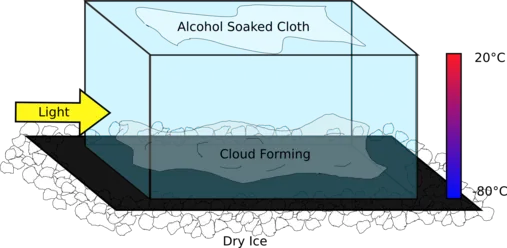
Some advanced hobbyists have pushed further still. Cloud chambers — the elegant vapor-based detectors that gave this publication its name — remain a popular project precisely because they make particle tracks directly visible to the human eye. A home-built diffusion cloud chamber, cooled by dry ice and filled with isopropyl alcohol vapor, will reveal the curved paths of alpha particles, the wispy trails of electrons, and the long, straight tracks of cosmic muons with no electronics required. The experience of watching subatomic physics unfold in real time, in one's own home, is described by nearly every practitioner as genuinely transformative.
"The first time I saw a muon track in my cloud chamber, I just stood there," recalls Priya Anand, a software developer in the Chicago area who built her chamber from a tutorial she found online. "You know intellectually that these things exist, but seeing the actual trail — knowing that something traveling near the speed of light just passed through my kitchen — it changes how you think about the world."
A Community Built on Shared Data
Perhaps the most consequential aspect of the DIY physics movement is not the hardware itself but the culture of data sharing it has cultivated. Online communities hosted on platforms such as Reddit, Discord, and dedicated forums aggregate measurements from hundreds of individual detectors, creating datasets that no single amateur could produce alone.
This distributed approach mirrors, in modest form, the collaborative model that defines professional high-energy physics. The Large Hadron Collider at CERN, for instance, is operated by a collaboration of thousands of researchers across dozens of institutions. Amateur networks operate on a far smaller scale, but the underlying philosophy — that shared data is more valuable than siloed data — is identical.
Researchers at several universities have begun to take notice. Collaborations between citizen science detector networks and academic institutions are producing peer-reviewed contributions in fields including cosmic ray physics, space weather monitoring, and detector technology development. The boundary between amateur and professional, once seemingly fixed, is proving to be more permeable than tradition suggested.
The Broader Meaning of Participation
The DIY particle detection movement carries implications that extend beyond physics. It represents a reclamation of experimental science as a practice available to anyone willing to engage seriously with it — not merely as a consumer of scientific results, but as a producer of scientific data.
In an era when public trust in scientific institutions faces complex pressures, the experience of conducting one's own experiments and arriving at one's own empirical conclusions may carry particular value. When Marcus Heller watches his detector register a muon event, he is not taking anyone's word for the existence of cosmic rays. He is observing the evidence himself, in his own basement, with instruments he built with his own hands.
That, in the end, may be the most important particle these detectors are capturing: not the muon, but the habit of inquiry itself.