Identical Trails, Irreconcilable Truths: The Interpretation Problem at the Heart of Particle Physics

There is something disarmingly straightforward about a particle track. A charged particle passes through supersaturated vapor, ionizes the air along its path, and tiny droplets condense around those ions like pearls on a string. The resulting trail is visible, photographable, and reproducible. For most of the twentieth century, this apparent simplicity gave the cloud chamber an almost unassailable authority. Seeing, it seemed, was believing.
But what, precisely, was being seen?
That question, deceptively modest in its phrasing, has occupied physicists and philosophers of science for nearly a century. And despite the extraordinary advances in detector technology that have transformed particle physics from a cottage industry of glass boxes and dry ice into a global enterprise of billion-dollar colliders, the question has never been satisfactorily resolved.
The Track Is Not the Particle
The first and most fundamental source of interpretive difficulty is one that practitioners rarely announce in their published papers: a particle track is not a particle. It is a record of a particle's interaction with a medium. The distinction matters enormously. What the cloud chamber — or any detector — captures is not the thing itself but a cascade of secondary effects, each step in the chain introducing its own assumptions and uncertainties.
When C.T.R. Wilson photographed his first tracks in the early 1900s, the scientific community largely treated the images as transparent representations of physical reality. The curvature of a track in a magnetic field gave you momentum; the density of droplets gave you ionization; the geometry gave you the particle's identity. The inference chain seemed clean and short.
Yet embedded in that inference chain were theoretical commitments that were anything but neutral. To read a track as evidence of an electron, a proton, or — as Carl Anderson famously concluded in 1932 — a positron, one must already accept an entire theoretical apparatus: relativistic quantum mechanics, the behavior of charged particles in electromagnetic fields, the statistical properties of ionization. The track does not speak for itself. It speaks through a framework, and frameworks can be wrong, incomplete, or contested.
When the Same Data Divides the Room
The interpretive problem sharpens considerably when identical experimental results are used to support contradictory theoretical conclusions. This is not a hypothetical concern. It is a recurring feature of the history of particle physics, and it remains alive in contemporary research.
Consider the situation that arose repeatedly during the mid-twentieth century as bubble chambers and spark chambers succeeded the cloud chamber in experimental prominence. Tracks that one theoretical camp interpreted as evidence for a particular resonance state were read by another camp as artifacts of background processes. The data were not in dispute. The ontological status of what the data represented very much was.
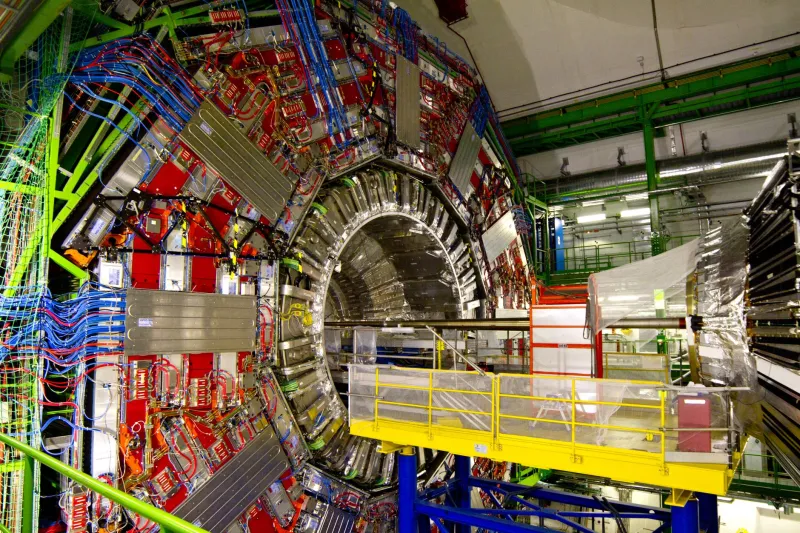
More recently, the interpretation of results from the Large Hadron Collider at CERN has produced analogous tensions. The 2012 announcement of the Higgs boson discovery was celebrated worldwide, yet within the physics community there remained — and remains — substantive disagreement about whether what was detected was the Standard Model Higgs, a composite particle mimicking its properties, or something else entirely. The statistical significance was not in question. The meaning of the signal was.
This is not a failure of experimental rigor. It is a structural feature of how scientific knowledge is constructed at the frontier, where theoretical frameworks are still being negotiated and where the instruments themselves encode assumptions about the phenomena they are designed to detect.
The Epistemological Inheritance of the Cloud Chamber
What makes the cloud chamber's legacy particularly instructive in this context is the way its apparent simplicity concealed the interpretive complexity that would later become unavoidable in more sophisticated detectors.
Early practitioners could point to a photograph and say, with reasonable confidence, that a track of a particular curvature and density corresponded to a particle of a particular charge-to-mass ratio. The visual directness of the evidence gave it rhetorical power that graphs and statistical distributions lack. Photographs could be published, displayed, and contemplated by anyone with eyes.
But that rhetorical directness was, in a sense, misleading. The photograph did not eliminate the interpretive layer; it concealed it. The theoretical commitments required to read the image were so thoroughly internalized by trained physicists that they became invisible — part of the background assumptions of the discipline rather than explicit claims open to scrutiny.
Philosophers of science, from Norwood Russell Hanson's influential work on theory-ladenness in the 1950s onward, have argued that all observation in science is shaped by prior theoretical commitments. The cloud chamber photograph is, in this reading, not raw data but already-interpreted data — a product of a particular set of assumptions about how charged particles behave, what supersaturation means, and how droplet formation relates to ionization. Strip away those assumptions and the image is just a pattern of light and dark.
Multiplying Detectors, Multiplying Interpretations
The proliferation of detector technologies over the past several decades has, paradoxically, intensified rather than resolved the interpretation problem. When a single type of detector dominated experimental particle physics, there was at least a shared vocabulary for discussing results. As wire chambers, calorimeters, time-of-flight detectors, and silicon vertex trackers came to be combined in ever more elaborate configurations, the interpretive complexity multiplied accordingly.
Modern particle physics experiments typically involve dozens of distinct detector subsystems, each sensitive to different aspects of a particle interaction, each requiring its own theoretical model to extract meaningful quantities from raw signals. The final "result" of such an experiment is not a photograph but a statistical inference derived from the combined outputs of all these subsystems, processed through layers of reconstruction software that embody thousands of individual theoretical and engineering choices.
In this environment, the question of what an experiment is actually detecting becomes genuinely difficult to answer. The signal that a physicist calls a "top quark event" is not a direct observation of a top quark — a particle with a lifetime so short it cannot traverse even a single proton width before decaying. It is a pattern of energy deposits and track segments that, when filtered through a reconstruction algorithm and compared against Monte Carlo simulations based on the Standard Model, is consistent with what a top quark decay would be expected to produce.
The consistency is real. The inference is valid within the framework. But the ontological claim — that a top quark was actually there, in some meaningful sense — depends entirely on the theoretical apparatus surrounding the measurement.
A Question the Data Cannot Answer
None of this is to suggest that particle physics is engaged in circular reasoning or that its results are without epistemic value. The predictive successes of quantum field theory are among the most impressive achievements in the history of human inquiry. The Standard Model, whatever its limitations, describes an extraordinary range of phenomena with remarkable precision.
But precision is not the same as transparency. The fact that a theoretical framework makes accurate predictions does not settle the question of whether its central entities — quarks, leptons, gauge bosons — correspond to features of an observer-independent reality or are, in some philosophically important sense, useful fictions: tools for organizing and predicting experimental outcomes rather than descriptions of things that exist in the way a rock or a river exists.
This question — sometimes called the debate between scientific realism and instrumentalism — is as unresolved today as it was when the first cloud chamber photographs were being interpreted in Cambridge a century ago. The tracks have multiplied, the detectors have grown vastly more sensitive, and the theoretical structures have become almost incomprehensibly elaborate. But the fundamental epistemological puzzle has not changed.
Particle physicists are still, at bottom, looking at patterns left behind by processes they cannot observe directly and inferring, from those patterns, something about the nature of matter and energy. The cloud chamber made that process visible in a way that was beautiful and immediate. What it could not do — what no instrument can do — was make it simple.
The ghost in the chamber was never the particle. It was always the question of what the particle means.