Measurement Without Meaning: The Unresolved Crisis at the Heart of Quantum Detection
There is a moment, familiar to anyone who has watched a cloud chamber in operation, when a thin white streak materializes from nothing — a vapor trail left by a particle that passed through supersaturated air and announced its presence to the visible world. It is a deeply satisfying image. It feels like evidence. It feels like seeing.
But what, precisely, has been seen?
That question, deceptively simple, sits at the center of one of the most consequential and stubbornly unresolved disputes in the history of science. Physicists can calculate particle behavior with a precision that rivals the most exacting measurements in any field of human inquiry. Yet when it comes to explaining what happens during the act of measurement itself — what occurs in the instant a particle interacts with a detector — the scientific community remains fractured along philosophical lines that have barely shifted since the 1920s.
This is the measurement problem, and it is not a footnote. It is a foundational crack running beneath every laboratory, every detector array, and every celebrated result in experimental physics.
A Wave That Collapses — Or Does It?
The standard formalism of quantum mechanics describes particles not as definite objects occupying definite positions, but as probability waves — mathematical structures called wave functions that encode the likelihood of finding a particle in any given state upon measurement. Before measurement, a particle exists in superposition: it has no single, determinate property. After measurement, it appears to have one.
The Copenhagen interpretation, developed principally by Niels Bohr and Werner Heisenberg in the late 1920s, offered an early and influential answer to this puzzle. Measurement causes the wave function to collapse, they argued — the probabilistic cloud of possibilities resolves into a single, concrete outcome the moment a detector interacts with a particle. The act of observation, in some irreducible sense, brings definiteness into being.
For most working physicists, Copenhagen became the default framework — not because it was philosophically satisfying, but because it was practical. It allowed scientists to calculate results and move on without dwelling on the metaphysics. As the saying often attributed to David Mermin neatly summarized the attitude: "Shut up and calculate."
But Copenhagen never truly explained the collapse. It simply asserted it. And for a generation of physicists unwilling to let the question rest, that assertion was never sufficient.
Many Worlds and the Proliferating Universe
In 1957, a Princeton doctoral student named Hugh Everett III proposed a radical alternative. Rather than collapsing upon measurement, the wave function never collapses at all. Instead, every possible outcome of a quantum event is realized — in separate, non-communicating branches of reality. When a particle hits a detector screen and appears to land at a single point, it has, in Everett's framework, landed at every possible point simultaneously. The universe has simply split into versions, each of which contains an observer who sees only one outcome.
The Many-Worlds interpretation eliminates the measurement problem by eliminating collapse entirely. It is, in a strict logical sense, internally consistent. But it purchases that consistency at an extraordinary price: an uncountably vast and perpetually multiplying multiverse, none of which can be observed or tested from within any single branch.
For critics, this is not a solution so much as a relocation of the mystery. Explaining what a detector measures by invoking infinite unobservable universes strikes many physicists as a cure considerably worse than the disease.
Objective Collapse and the Search for Physical Reality
A third class of interpretations attempts to treat wave function collapse not as a postulate or a philosophical maneuver, but as a genuine physical process — one that operates according to discoverable laws and produces testable predictions.
Objective collapse theories, the most mathematically developed of which is the GRW model (named for physicists Ghirardi, Rimini, and Weber), propose that wave functions collapse spontaneously at random intervals governed by a new physical constant. For a single particle, this collapse is extraordinarily rare. For a large aggregate of particles — a detector, a human eye, a measuring apparatus — collapses compound rapidly, effectively guaranteeing that macroscopic objects always have definite properties.
This approach has genuine scientific appeal: it modifies quantum mechanics in ways that are, at least in principle, experimentally distinguishable from the standard theory. If spontaneous collapse occurs, it should produce faint, measurable deviations from standard quantum predictions in certain experimental contexts. Several research groups have designed experiments specifically to test for these deviations.
So far, none have been found. Objective collapse theories remain viable, but unconfirmed — a serious candidate without a decisive experimental verdict.
The Detector's Silent Testimony
What makes this debate particularly pointed for experimental physicists is that detectors themselves are implicated in the problem they are meant to resolve. A cloud chamber, a silicon strip tracker, a photomultiplier tube — these instruments do not passively record pre-existing facts about particles. According to the very formalism that makes them useful, they participate in the production of those facts.
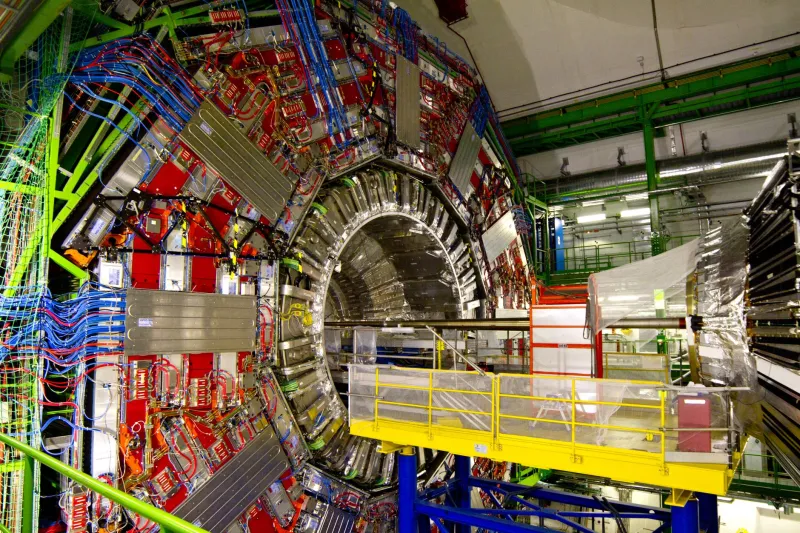
This is not merely a philosophical observation. It has practical consequences. When researchers at major facilities such as Fermilab or CERN analyze detector data, they are interpreting signals that quantum mechanics insists were indeterminate before the detection event. The interpretation of what that data means — what it says about the particle prior to measurement — depends entirely on which foundational framework one adopts.
Under Copenhagen, the question of what the particle was doing before measurement is simply unanswerable, and asking it is regarded as a category error. Under Many-Worlds, the detector registered every possible outcome, and only the branching structure of reality gives the impression of a single result. Under objective collapse, the detector triggered a real physical process that localized the particle's properties in space and time.
Three detectors, three results, three entirely different stories about what happened.
Why Technology Has Not Settled the Question
One might expect that a century of increasingly sophisticated instrumentation would have forced a resolution. Particle detectors have advanced from Wilson's glass-and-alcohol cloud chambers to room-temperature semiconductor arrays capable of resolving tracks to within microns. Quantum computing experiments now manipulate individual qubits with exquisite control. Quantum optics laboratories routinely perform experiments that early pioneers could not have imagined.
None of this has touched the measurement problem. The reason is fundamental: the competing interpretations are, in most experimentally accessible regimes, mathematically equivalent. They make the same predictions. A more sensitive detector does not adjudicate between Copenhagen and Many-Worlds because both frameworks accommodate its results with equal facility.
The disagreement is not, in the conventional sense, an empirical one — or at least not yet. It is a disagreement about the ontological furniture of reality: about whether wave functions are real physical entities or calculational tools, about whether measurement is a physical process or a conceptual boundary, about whether the universe is fundamentally deterministic or irreducibly probabilistic.
The Fog That Remains
Cloud chambers made the invisible visible. That achievement was genuine and transformative. But visibility is not the same as understanding, and the trail of condensed droplets that traces a charged particle's path through supersaturated vapor does not, by itself, tell us what that particle was before it entered the chamber, or what the act of leaving a trail actually means.
The measurement problem endures not because physicists have been inattentive or philosophically unsophisticated. It endures because the question it poses — what is the relationship between the mathematical description of a quantum system and the physical reality that description is meant to represent — may be the deepest question that experimental science has ever confronted.
The cloud clears. The track appears. The debate continues.