Static, Ghosts, and False Signals: The War Against Noise in Particle Detection
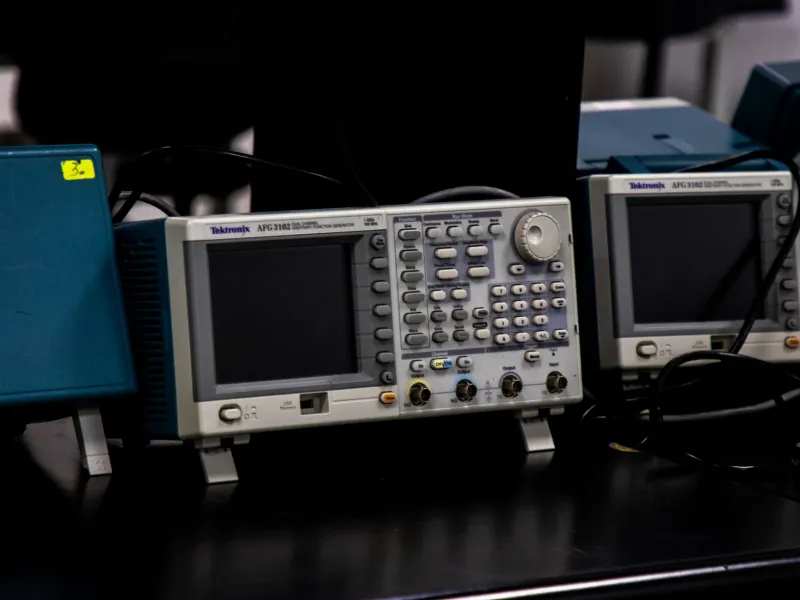
There is a moment familiar to anyone who has ever built or operated a particle detector — amateur or professional — when the readout behaves in a way that cannot be explained by physics. A spike appears on the oscilloscope. A track materializes in the vapor that curves the wrong direction. A count registers when the source is shielded and nothing should be passing through. The instinct is excitement. The reality, more often than not, is noise.
Noise — in the broadest engineering sense — is any signal that does not correspond to the physical phenomenon you are trying to measure. In particle detection, it is not a minor inconvenience. It is, for many experiments, the primary obstacle between a researcher and a meaningful result. And yet, in popular accounts of physics, it is almost entirely invisible.
What Counts as Noise, and Why It Is Harder to Define Than It Sounds
The word itself is deceptively simple. In particle physics instrumentation, noise encompasses a remarkable range of phenomena. Thermal noise arises from the random motion of electrons in any conductor at temperatures above absolute zero. Shot noise emerges from the discrete, statistical nature of electric charge flowing through a circuit. Electromagnetic interference — often abbreviated EMI — arrives from external sources: nearby motors, fluorescent lighting, cell phone towers, even the switching power supplies inside the detector's own electronics.
Then there are the subtler contributors. Radioactive contamination in detector materials can mimic genuine signals. Cosmic muons, the very particles many amateur detectors are designed to catch, become background noise in experiments searching for something rarer. In cryogenic detectors operating near absolute zero, vibrations from building HVAC systems can couple mechanically into sensitive components and register as false events.
At large professional facilities, the distinction between signal and noise is negotiated through elaborate trigger systems — hardware and software architectures that apply real-time filters to incoming data, discarding events that fail to meet predetermined physical criteria. At the Large Hadron Collider, roughly one billion proton collisions occur every second. The trigger systems retain fewer than one thousand of them for permanent storage. The rest are, by engineering necessity, discarded as noise or uninteresting background.
The Financial Weight of a Contaminated Dataset
The consequences of noise contamination extend well beyond frustration. In professional physics, a dataset corrupted by uncharacterized noise sources can invalidate months of beamtime — time that costs institutions millions of dollars to secure. The 2011 OPERA experiment, which briefly appeared to show neutrinos traveling faster than light, offers a cautionary example: the anomalous result was ultimately traced to a loose fiber optic cable and a faulty oscillator clock — hardware artifacts that injected a systematic timing error into what otherwise appeared to be clean data. The episode consumed enormous institutional resources and, for a period, generated significant public confusion about established physics.
For smaller university groups operating on tight grant budgets, noise problems are equally punishing, if less publicly visible. A graduate student who spends six months collecting data, only to discover that a poorly shielded cable was inducing periodic false triggers, faces a timeline crisis that can affect the trajectory of an entire research program.
The Amateur Dimension: Noise in Home-Built Detectors
The noise problem is not confined to professional laboratories. The growth of amateur particle physics in the United States — a community of home experimenters building cloud chambers, Geiger counters, and scintillation detectors in garages and basements — has brought the same engineering challenges into domestic settings, often without the institutional support structures that help professional teams diagnose problems.
A common experience among first-time cloud chamber builders involves erratic behavior that appears, initially, to be extraordinary physics. Tracks that move laterally without an applied magnetic field. Droplets that nucleate in patterns too regular to be random. Counts that spike reliably every few minutes. In nearly every case, careful investigation reveals a mundane culprit: a fluorescent light on the same circuit, a refrigerator compressor cycling nearby, or a ground loop introduced by connecting multiple pieces of equipment to different outlet strips.
Ground loops — circuits formed unintentionally when two pieces of equipment share a common ground through different paths — are among the most persistent and least intuitive noise sources in amateur instrumentation. They can induce 60-hertz hum directly into signal lines, producing a periodic false signal that, on an oscilloscope trace, looks disturbingly like a real detection event.
Emerging Approaches to Noise Suppression
Both professional and amateur communities are developing increasingly sophisticated responses to these challenges. At the professional level, machine learning techniques are being applied not just to particle identification but to noise characterization. Neural networks trained on known noise signatures can flag suspicious events in real time, allowing trigger systems to make more nuanced decisions than simple threshold cuts permit.
In the realm of hardware, advances in low-noise amplifier design have significantly improved the signal-to-noise ratio achievable in silicon detector systems. Correlated double sampling — a technique that measures the baseline noise level immediately before each signal integration and subtracts it — has become standard in many charge-coupled detector architectures, dramatically reducing the contribution of thermal noise to readout uncertainty.
For amateur builders, the solutions are often lower-tech but equally effective. Faraday cages — enclosures made of conductive mesh or sheet metal that block external electromagnetic fields — can be constructed inexpensively and retrofitted around sensitive detector components. Proper grounding discipline, meaning ensuring that all components in a detection system share a single, low-impedance ground reference, eliminates most ground loop problems. Battery-powered preamplifiers, isolated from the AC power grid entirely, remove one of the most common EMI pathways in home-built systems.
Shielded twisted-pair cable, the same technology used in professional audio and networking applications, is increasingly popular among serious amateur detector builders for connecting sensitive analog stages. The twisting geometry causes electromagnetic fields to induce equal and opposite voltages in adjacent conductor segments, canceling most interference before it reaches the readout electronics.
Noise as a Scientific Discipline
What is perhaps most striking about the noise problem is that, over time, it has generated its own scientific subdiscipline. Detector physics — the study of how instruments respond to particles and how that response can be optimized and characterized — is now a recognized specialty within experimental physics, with dedicated journals, conferences, and graduate programs.
The insight driving this field is that noise is not simply an obstacle to be minimized. It is a physical phenomenon, subject to the same rigorous analysis as any other measurable quantity. Characterizing the noise floor of a detector — mapping its frequency spectrum, identifying its sources, modeling its statistical behavior — is not a preliminary chore to be completed before the real science begins. It is, in many respects, the foundation upon which all subsequent measurements rest.
For the amateur physicist in a converted basement, that perspective offers something genuinely useful: the recognition that understanding why your detector misbehaves is not a distraction from particle physics. It is particle physics, approached from the engineering end. The cloud chamber does not lie. It simply requires that you learn to read what it is actually saying.